
If you're not new here, you know that most of my older posts read more like technical articles than opinion pieces. So, to change things up, this is probably the first "true" blog post I publish here. I'm going to share a personal (subjective) opinion, with the goal of getting you thinking about the direction our industry is heading.
I've always been lucky to work on something I love, and to enjoy the actual process of making it. I got my first job as a programmer at 17, and even then I understood what a privilege it was to have fun and get paid for it.
A few days ago, while playing music with some friends, we drifted onto the topic of how music production quality has dropped over the last few decades, and how the value people place on music has changed.
Everyone in the group is in their late 30s or early 40s, so our view is shaped mostly by the last 30 years. And, as you might expect, our group of boring middle-aged men agreed that:
- Overall, the quality and refinement of music production have decreased.
- Music has lost some of its value and no longer feels as essential as it once did.
To be clear, we're not saying great music isn't still being made. There are plenty of talented people making excellent music right now. The problem is that most people will never hear their names, and they get little visibility or recognition.
So here is my (controversial) take, up front:
And I believe software is heading down exactly the same road music already took.
What Happened to Music
When we tried to work out why, we kept landing on the same answer: making music became easy and cheap.
Thirty years ago, recording a decent album meant a studio, an engineer, tape, rented time, and a label willing to bet money on you. That cost was a filter. It wasn't a fair filter, and plenty of great artists never got through it, but it meant that whatever reached the shelves had been worked on, argued over, and polished, because a lot of money and many people's time were riding on it.
Then the tools got cheaper. A laptop, a DAW, and a pair of headphones replaced the studio. Loops, presets, sample packs, Auto-Tune and, more recently, AI generation removed most of the remaining friction. Distribution followed the same path: you no longer needed a label or a record shop, just an upload button.
On paper this is wonderful, and in many ways it is. Far more people can make music now. But a couple of things happened alongside it:
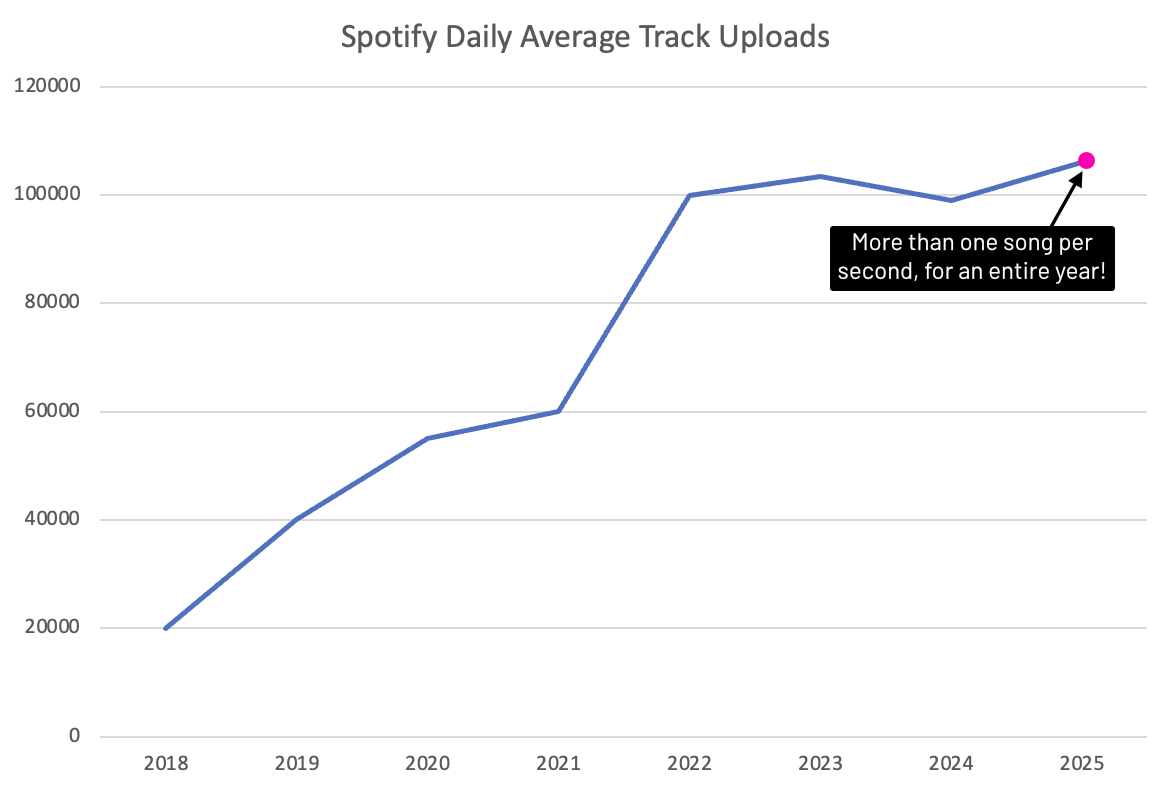
- Volume exploded. Record label executives have put new uploads at roughly 100,000 tracks a day across platforms, and even the lower estimates had Spotify alone taking in around 49,000 a day. Nobody can listen to more than a tiny fraction.
- The craft got skipped. When the tools do the hard parts for you, it becomes possible to release something without ever learning why it works. A lot of what gets published sounds "fine," and fine is the problem.
- Value moved away from the work. When something is endless and almost free, people stop treating it as precious. We used to save up for an album, play it until we knew every second of it, and read the liner notes. Today music is mostly background, a flat monthly fee for access to everything, which in practice means attachment to very little.
- Visibility replaced quality. With so much out there, what wins is not necessarily the best work but whatever the algorithm, the marketing budget, or a viral moment pushes. Formulaic, safe, generic tracks are perfectly suited to that system.
Two Acts
One of my favorite music commentators, Rick Beato, discusses this point very well in his remarks on the history of the music business and technology. He splits this into two acts, and both map very well onto what I'm also observing in other industries.
Act One: Too Easy to Make
In the 1940s and 50s, Frank Sinatra stood in front of an orchestra with one microphone and sang the take. Then came multitrack machines and punch-ins, then Auto-Tune in 1998, then tools like Beat Detective that snap every drum hit to the grid. The swing and the human feel is simply gone!
- Budgets went, craft went with them. Around 2000, the money to hire great session drummers dried up. Instead of better musicians, records got fixed in the computer: the drums, then the bass, then the guitars.
- Presets instead of skill. Amp modelers, preset sounds, and MIDI packs with pre-programmed chord progressions mean everyone is using the same algorithms.
- Everything starts to sound the same. Over-reliance on the same tools makes music more formulaic, which is why, he argues, the same trap beats have been in vogue for so long: people know they work, so they keep using them.
- Quantity over quality. Easier production means faster production, which means an oversaturated market where exceptional work is harder to find.
"Sterile, generic, quantized rock music that has no vibe at all. They're so easy to use, doesn't take any skill at all, but it doesn't take any creativity either."
And then there's AI. Beato even mentions he gets about 20 emails a day that start with something like "I wrote a song that I think can be a hit. I used AI to do it because I know nothing about making music."
He also makes a point that stuck with me: even the shortcuts depend on craft. Samples come from people who knew how to record them. AI models are trained on music made by people who knew how to make it.
Act Two: Too Easy to Consume
The current state of streaming is similar to a kitchen tap. Turn it on... music flows down the drain, then turn it off.
In 2025, more than 100,000 new songs were added to streaming platforms every day! That's more than one song per second, for the entire year.
Now, if you are as old as I am, you probably remember the perceived value that one single track had! And that value was both financial and emotional. We mowed other people's lawns to be able to buy a 10-dollar record, then we played it over and over. Got used to it. Learned from it. That single album (which was already designed and crafted with a sequence of songs in mind) took us months to consume. We shared them with friends, read the credits on the back cover, spoke about our favorite artists when we should be paying attention in school, and many of those songs became almost supporting characters in the most special moments of our lives.
Today, all of Bach, Michael Jackson, Miles Davis, and Kendrick Lamar costs $10.99 a month, which is the price of what we used to pay for one album!
With no sweat equity put into obtaining it, music stopped being part of people's collection and part of their identity. If you can have everything for $10.99 a month, what is one song worth? People say they want more ambitious music, but in the end they "vote with their attention," and attention goes to whatever is easiest.
What struck me most is that none of this is really about talent. It's what happens to any craft when making it becomes nearly free, consuming it becomes nearly free, and the reward for doing it well disappears. Good music didn't disappear. It got buried, and the average experience of music got thinner.
I confess I had to pause and really reflect about these ideas. My mind is in conflict because we often tend to think of "democratization" as something inheritely good and unquestionable (sacrosanct).
Is Software Next?
For most of my career, the process of crafting software required some sweat. Even when I was working with dumbed-down technologies, like MUMPS and ZIM-L4G (both designed to be easy and tailored for rapid-development), the entire team was required to understand the language, the platform, the architecture, the edge cases, and the hundred small decisions that separate something that works from something that works well. That difficulty was our studio time and our tape. It slowed everyone down, and it also forced a certain level of care.
AI is removing that friction at a speed music never experienced. Today someone with no programming background can describe an app in a few sentences, "vibe code" their way through the errors, and publish it the same afternoon. App stores, game stores, plugin marketplaces, and SaaS directories are already filling up with titles that look alike, work alike, and were clearly cheap to make.
Putting music and software examples next to each other, and they line up almost one for one:
| Music | Software |
|---|---|
| Quantized drums that are "perfect" but have no feel | Generated code that technically works, but nobody truly understands |
| Amp modelers, presets, and MIDI chord packs | The same templates, UI kits, and AI-suggested patterns in every app |
| "I used AI because I know nothing about making music" | "I built this app with AI and I know nothing about programming" |
| Samples come from people who knew how to record them | AI coding tools were trained on decades of code by people who knew what they were doing |
| 100,000 new songs a day | A thousand nearly identical to-do apps, games, and SaaS clones |
| Everything for $10.99 a month | An expectation that software should be free, or nearly free |
If the music story is any guide, I expect a few things to follow:
- A flood of "fine." Most of these products will technically work. They'll also be generic, shallow, and built without any real understanding of the problem, the user, or the code underneath. Nobody will have sweated over the details, because nobody had to.
- Hidden costs pushed onto users. In music, low effort mostly means a boring song. In software it can mean security holes, lost data, abandoned products, and bugs nobody understands well enough to fix, including the person who "wrote" it.
- Value draining from software itself. If anything can be generated in an afternoon, people will start expecting software to be free or nearly free, the same way they now expect music to be. That pressure lands on everyone, including the teams still doing careful work.
- Discovery becoming the real product. When there are a thousand nearly identical apps, the one that wins is rarely the best built. It's the one with the best marketing, the best SEO, or the luckiest launch.
I want to be fair here: lowering the barrier is not a bad thing in itself. Plenty of people who were locked out of building software will now make genuinely useful things, just as home recording gave us artists who would never have gotten a record deal. I use these tools myself. The question isn't whether ease of creation is good or bad. It's what happens to quality and value when effort stops being part of the price.
The Exceptions
Great music is still being made, and I know great software will still be made. But look closely at the exceptions in music today and you'll notice a pattern: they are the people who chose the hard way when the easy way was right there. The band that records live in a room looking for a 'warm-sounding' song. The drummer who refuses to be quantized. The artist who spends two years on an album instead of two days on a track. They are exceptions precisely because they go against the easy, cheap way of making things.
I think software will go the same way. When generating something becomes trivial, the scarce things become:
- Taste: knowing what to build, and just as importantly, what to leave out.
- Understanding: knowing why the code works, so you can fix it, secure it, and evolve it for years, not just ship it once.
- Care for the details: the parts no prompt asks for. The edge case handled gracefully, the error message that actually helps, the screen that loads fast on a bad connection.
- Trust: being the team people know will still be there, still maintaining the product, next year.
None of that comes from the tool. It comes from people who enjoy the process enough to keep caring about it! Similar to a 17-year-old who couldn't believe he was getting paid to have fun writing obscure config files for HP-UX servers.
Is there a Conclusion?
So, does ease of creation lower quality and value? My honest answer is yes, overall it does. And I know this sounds horribly elitist, but I'm trying to set aside my automatic aversion to the word elitist and honestly examine whether we're losing more than we're gaining when we become too concerned about offending (or even excluding) others.
Ease of creation lowers the minimum effort needed to put something out into the world, and the average quality drops with it. Quality doesn't disappear completely, but it becomes the exception rather than the norm: diluted, harder to find, and easier to undervalue. Music didn't lose its great artists. It lost the conditions that made people notice and value them.
Software is standing at that same door right now. We can let it become an endless stream of cheap, generic titles, or we can use these new tools to spend less time on the boring parts and more time on the parts that actually matter.
I don't have a neat conclusion, and that's fine. This was never meant to be a technical article. So I'll leave you with the question my friends and I couldn't settle:
I'd genuinely like to hear what you think. You can yell at me on Twitter. And if you're one of those people who enjoys learning how things really work under the hood, remember to visit the courses page.
See you inside!